
Your AI pilot worked in the demo. It answered questions accurately, automated a workflow, or helped a team finish tasks faster. Then months passed, and it still isn’t live.
If that sounds familiar, you are not alone. For growing businesses without a dedicated AI team, the step from a working demo to a live solution is where most AI initiatives stall. The real question is what happens when your customers and staff start relying on it. Check your AI readiness to understand whether your AI initiative is ready for production.
Can it handle inconsistent data, unexpected inputs, security requirements, model updates, and higher workloads? Can your team monitor its performance, control its costs, and take responsibility when something goes wrong?
That is where the difference between an AI pilot and a production-ready solution becomes clear.
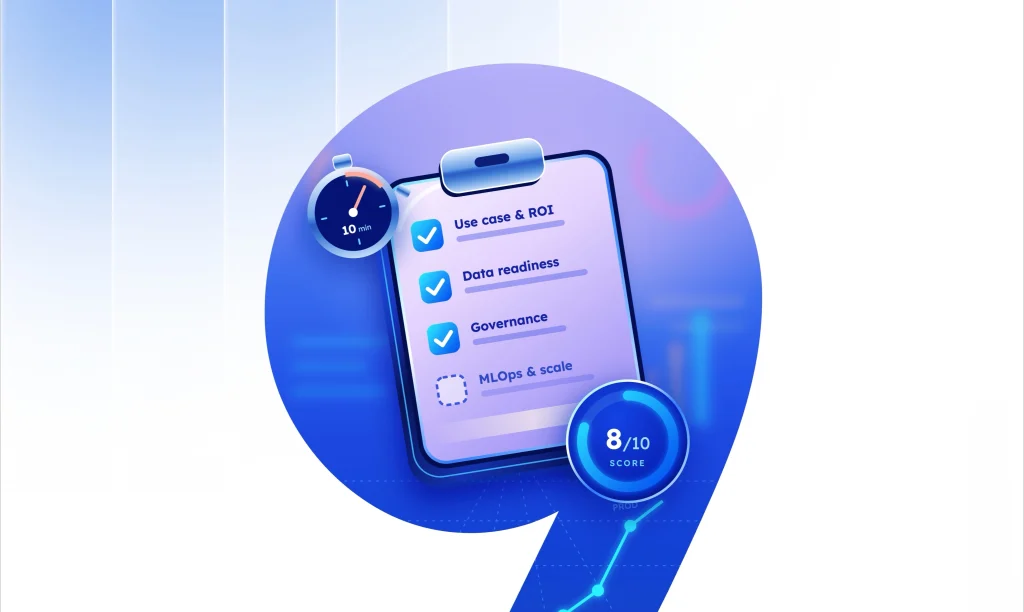
This 24-point AI production readiness checklist helps you assess whether your AI initiative is ready to move beyond experimentation. It covers eight areas: quality, human review, data and access, cost, reliability, model changes, security and trust, and ownership and business value.
Answer each question with Yes or No. You can complete the assessment in about 10 minutes, ideally with your tech lead or AI vendor alongside you.
Why Do AI Pilots Stall Before Production?
Moving an AI pilot into production is harder than proving that the technology works. Organizations must also address data quality, security, cost, reliability, and business value before AI can become part of everyday operations.
The latest industry research highlights this challenge:
- Gartner (January 2026): At least 50% of generative AI projects had been abandoned after the proof-of-concept stage by the end of 2025. Gartner identified poor data quality, inadequate risk controls, escalating costs, and unclear business value among the reasons.
- Deloitte (January 2026): Only 25% of respondents said their organizations had moved 40% or more of their AI pilots into production, according to its State of AI in the Enterprise research.
- McKinsey (2025): Nearly two-thirds of respondents said their organizations had not yet begun scaling AI across the enterprise, according to The State of AI in 2025.
These findings highlight three connected challenges: projects getting abandoned after proof of concept, difficulty moving pilots into production, and limited progress in scaling AI across the enterprise.
Getting an AI pilot to work is one milestone. Making it reliable, secure, cost-effective, and ready for wider business use is another. For small and mid-sized businesses, the stakes are higher: with tighter budgets and leaner teams, a stalled pilot ties up money and attention you cannot afford to waste. That is why it pays to check production readiness before you scale.
What Does Production-Ready AI Actually Mean?
An AI solution is production-ready when it can perform its intended business task consistently under real operating conditions, with appropriate controls, monitoring, and accountability.
A successful demonstration is not enough. A production-ready solution needs to work with real data, support actual users, integrate with existing systems, and handle failures without putting business operations at risk.
Here is how the requirements differ:
| Area | AI Pilot | Production-Ready AI |
|---|---|---|
| Data | Uses sample or prepared datasets | Works with approved, real-world data and defined data-quality checks |
| Quality | Tested against a limited set of examples | Evaluated against representative cases with measurable acceptance criteria |
| Human Review | Depends on informal feedback | Has defined review and approval steps for higher-risk outputs |
| Cost | Uses a limited testing budget | Has measured cost per task, usage limits, and budget controls |
| Reliability | Works in a controlled environment | Has monitoring, error handling, fallback processes, and recovery plans |
| Security | Uses basic or temporary access | Applies role-based access, data protection, and security controls |
| Ownership | Managed by the pilot team | Has named business and technical owners |
| Maintenance | Changes are handled as needed | Model, prompt, data, and workflow changes are tested and monitored |
The 24-Point AI Production Readiness Checklist
Use this checklist to evaluate whether your AI application is ready for real-world deployment.
Answer every question honestly. Tick a box only when the practice is already implemented and working. Planning to implement something later counts as a no.
Prefer to complete the assessment with your team? Download the printable AI Production Readiness Scorecard.
1. Quality: Can You Prove Your AI Works?
A successful demonstration doesn’t guarantee consistent performance in production. You need repeatable testing against realistic scenarios.
- We have a test set containing real-world examples, including unexpected and complex inputs.
- Every change to the AI’s instructions (prompts), model, or application is tested against this set before release.
- A designated person owns AI quality and reviews performance issues regularly.
2. Human Review: Do People Approve What Matters?
Human oversight helps businesses manage risks when AI-generated decisions or actions could have significant consequences.
- We have identified which AI decisions require human approval based on their potential impact.
- Reviewers can access the supporting information or sources needed to evaluate AI-generated results.
- We track how frequently reviewers correct, reject, or modify AI-generated outputs.
3. Data and Access: Does Your AI Only See What It Should?
AI applications often process sensitive business information. Access controls and data governance must remain consistent with the permissions of the users and systems involved.
- AI applications only access data that the requesting user or process is authorized to use.
- AI-generated answers provide references to supporting sources wherever applicable.
- We know what information leaves our systems, where it is processed, and which external services receive it.
4. Cost: Do You Know What AI Costs Per Customer or Task?
AI usage can increase as more customers and workflows rely on automated features. Without cost visibility, it becomes difficult to manage spending.
- We track AI costs per customer, task, or business workflow.
- We use cheaper AI models for simple tasks and reserve more expensive models for complex ones.
- We receive alerts when AI usage or spending increases unexpectedly.
5. Reliability: What Happens When Something Breaks?
Production systems must handle unexpected failures without disrupting the entire application.
- If our AI provider or service goes down, the work still gets done through a tested backup process.
- We have tested the AI with the volume of users and requests we expect after launch.
- We have set limits so the AI cannot run endlessly, keep retrying, or take actions beyond its intended scope.
6. Model Changes: What Happens When Your AI Model Updates?
AI model updates can affect response quality, accuracy, latency, and application behavior. Businesses need a controlled process for managing these changes.
- We know which AI model version we use and are notified when the provider changes it.
- We re-test the AI against our test set before switching to a new model version.
- If an update makes results worse, we can quickly switch back to the previous version.
7. Security and Trust: Can You Demonstrate What Your AI Does?
AI applications need appropriate security controls, traceability, and safeguards against misuse.
- Every important AI action and human approval is recorded in an accessible audit trail.
- We can explain our AI data handling, security controls, and governance practices during customer security reviews.
- We have tested whether someone could trick the AI into revealing data or doing things it should not (for example, through prompt injection).
8. Ownership and Business Value: Who Is Accountable, and Is It Paying Off?
AI systems need clear ownership beyond the development stage. Someone must be responsible for monitoring, maintenance, ongoing improvements, and proving that the AI delivers a measurable return.
- One designated person or team owns the AI application in production.
- We have a written guide for handling AI issues and a dashboard that shows how the application is performing.
- We have defined the business outcome this AI must deliver (such as hours saved, cost per task, or revenue influenced), and we measure it against a target.
How to Score Your AI Production Readiness
Count the number of Yes answers. Each Yes is worth one point, giving you a maximum score of 24.
| Score | Readiness Level | What It Means |
|---|---|---|
| 0–12 | Still in the Pilot Stage | Most growing businesses start here. Important production requirements are missing, so fix the highest-risk gaps before expanding usage. |
| 13–19 | Getting Closer | Your solution has a foundation, but some areas need attention before a wider rollout. |
| 20–24 | Strong Production Readiness | Your solution appears to have many of the necessary foundations for production. Validate critical controls before deployment. |
Important: A high score does not automatically mean your AI solution is safe to deploy. A critical gap in security, data access, human approval, or failure handling can make a solution unsuitable for production even if its overall score is high.
Use the score to identify where you need to focus, not as a substitute for technical, security, or business approval.
What Should You Fix First?
Your score tells you how prepared your AI initiative is. Your unanswered questions tell you where to start.
Use these priorities to plan your next steps:
| If You Answered No To… | Start By… |
|---|---|
| Quality and evaluation | Creating representative test cases and defining measurable acceptance criteria |
| Human review and approval | Setting review thresholds, escalation rules, and approval responsibilities |
| Data and access | Reviewing data quality, permissions, and sensitive-data handling |
| Cost and usage control | Measuring cost per successful task and setting production usage budgets |
| Reliability and failure handling | Testing failure scenarios, retries, fallbacks, and monitoring |
| Model and workflow changes | Introducing version tracking, regression testing, and rollback procedures |
| Security and trust | Reviewing access controls, prompt-injection risks, and audit logging |
| Ownership and business value | Assigning accountable owners and defining measurable business outcomes |
Do not try to fix everything at once. Start with gaps that could create the greatest risk to customers, business operations, data, or compliance.
Get Your AI Production Readiness Scorecard
Want to assess your AI initiative with your team?
Download the AI Pilot to Production Scorecard. It includes:
- All 24 production-readiness checks.
- Eight assessment categories.
- A scoring guide to understand your readiness level.
- Practical explanations of what each check means.
- A starting point for prioritizing the gaps that need attention.
Download Your AI Pilot to Production Scorecard
Want to Help Understanding Your Score?
Share your assessment score and the areas where you answered No. The 9series team can help you identify the gaps that should be addressed first.
You can request a free fix-first plan within 48 hours, prepared by Claude Certified Architects. It will outline the areas to prioritize and practical next steps for improving your AI solution’s production readiness.
No sales pitch. No obligation.
How 9series Helps Move AI Initiatives Toward Production
Moving an AI initiative beyond a proof of concept takes more than model development. It requires engineering, integration, evaluation, security, monitoring, and ongoing ownership.
9series works with businesses to build and improve AI-based solutions with a focus on practical business requirements and production needs.
Relevant project experience includes:
- Port operations modernization: Testing and modernization work reduced post-release defects by 35%.
- Lion HQ investment research platform: The platform was designed with failover capabilities supporting 99%+ uptime.
- US sports technology startup: Built an auditable development trail to improve visibility and accountability across the development process.
These examples reflect different engineering challenges. Results depend on the project’s scope, requirements, and operating environment.
9series is a Certified Service Partner in the Claude Partner Network. Its team includes 13 Claude Certified Architects – Foundations and 68 Claude Certified Associates – Foundations. 9series also maintains a SOC 2 Type II audit report.
Explore 9series AI Development Services
FAQs
An AI pilot is ready for production when it meets defined quality standards, works with approved real-world data, has appropriate security and human-review controls, and can be monitored and maintained. Use a structured readiness assessment to identify gaps before deployment.
An AI production readiness checklist is a set of questions used to evaluate whether an AI solution is prepared for real business use. It typically covers output quality, data, security, costs, reliability, monitoring, human oversight, and ownership.
AI projects can fail after proof of concept because the requirements for production are more demanding than those for a controlled demonstration. Gartner identified poor data quality, inadequate risk controls, escalating costs, and unclear business value among the reasons generative AI projects are abandoned after proof of concept.
Businesses should test output quality, performance across representative inputs, data access, security, failure handling, integration, operating costs, and human approval workflows. Testing should reflect the conditions the solution will face in production.
The cost of moving an AI pilot into production depends on the solution’s complexity, data requirements, model usage, infrastructure, integrations, security controls, and monitoring needs. Businesses should estimate the total operating cost at expected production usage rather than relying only on pilot-stage expenses.
An AI pilot tests whether a proposed solution can work in a limited or controlled environment. Production AI is deployed for real users and business workflows, with defined performance standards, security controls, monitoring, failure handling, and ongoing ownership.
Some low-risk AI tasks can operate with limited intervention, but businesses should define where human review or approval is required. Decisions involving sensitive information, customers, finances, legal matters, or important business actions may need additional oversight.
Businesses should review AI production readiness before deployment and whenever significant changes affect the model, prompts, data, integrations, usage, or business requirements. Ongoing monitoring also helps identify performance, cost, security, and reliability issues after launch.